Showing posts with label library. Show all posts

Friday, February 21, 2014

Biblioclasm Today

More than 200 copies of books about Anne Frank, including the diary which the Jewish teenager wrote in hiding during the second world war, have been deliberately vandalized in libraries across Tokyo.

Anne Frank

In this case, Anne Frank's book and the many books about her are widely published.  There are no shortage of them.  These are not rare manuscripts. However, her diary is symbolic.  It is more important the the words it contains.  Thus, those who disagree with that symbol strike out at it.  Why?  Because books are easy targets and still the most meaningful object to a culture.
Fortunately, her book is a powerful symbol and I bet that over the next couple of days the libraries in Japan will rebound from this and restore her work to the shelves.

Biblioclasm
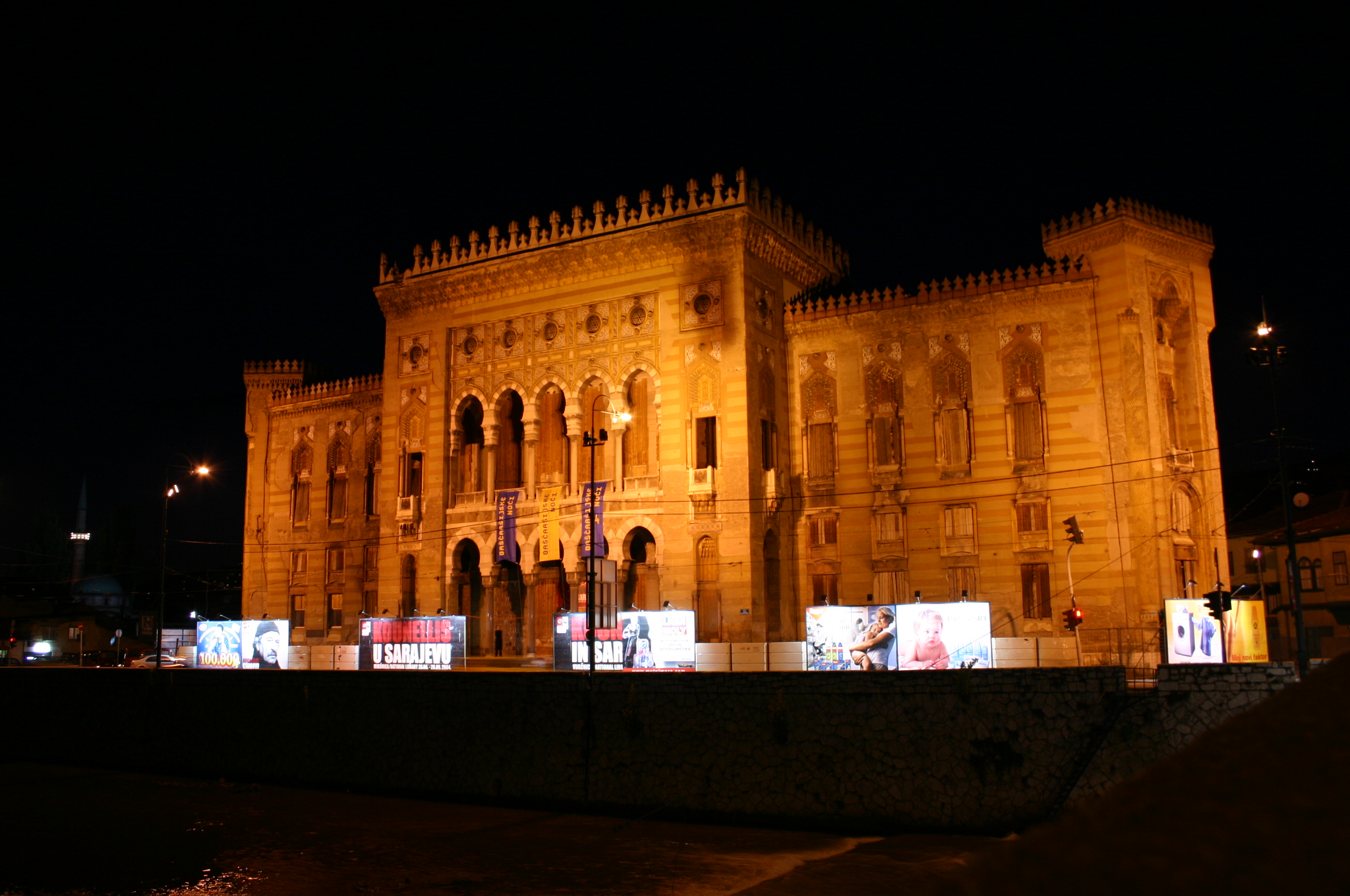
The National and University Library of Bosnia-Herzegovina was shelled and burned for three straight days in August of 1992 during the three year civil war in that country.  Over two million books were lost and many priceless manuscripts.  The library itself did not hold any strategic value (Zeco, 1996).  The Vijecnica as it was called, was the former city hall built in a pseudo-Moorish style at the end of the nineteenth century.  It was a symbol of the city and the cultural heritage of the region (Zeco, 1996).
The library was targeted over this three day period by Serbian nationalists as part of the “cultural genocide” on the Muslim population in the region.  During the trial of former Serbian president Slobodan Milosevic, the destruction of the library was offered as proof to support his conviction for crimes against humanity before The Hague (Kuntz, 2012).
As Knuth (2006) states, books are easy targets because of their “symbolic nature and relative vulnerability” (p. 11).  Sometimes books are banned because of the information they contain.  Many times, however, it’s not only because of the content of the books themselves but also because of their importance to a particular culture (Knuth, 2006, pp. 11, 29).
This can be seen with the recent burning of Islamic religious texts by a Florida pastor in 2012.  The texts themselves were not unique.  What they contained had been reproduced millions of times over.  The words they contained, however, were important to the culture that associated with them.
The destruction of libraries is important in war as a tactical target.  The loss is meant to instill fear.  “The loss of libraries signals to the population that they are vulnerable to the enemy and a superior army (Knuth, 2006, p. 11).
The Vijecnica after its destruction.
The destruction of the Vijecnica was not an isolated incident.  Shortly before, in May of that year and one month into the start of the war, the Serbians destroyed the Oriental Institute, a cultural heritage institution that archived many important documents from the region's past.  Lost were many valuable manuscripts, including an important collection called Manuscripta Turcica.  In addition, many civil and land records from the nineteenth century were targeted and destroyed.  The destruction of these texts and records are consistent with biblioclasm’s effort to erase all cultural records of a people (Zeco, 1996).
Biblioclasm’s aim is not the destruction of the book qua book.  Instead it focuses on books because they are vulnerable and important symbols of society.  By destroying a library, the aggressor is effectively annulling the UDHR’s application to the victims by announcing very plainly: you have no rights.
References
Joyner, C. C. (2004). The United Nations and Terrorism: Rethinking Legal Tensions Between National Security, Human Rights, and Civil Liberties. International Studies Perspectives, 5(3), 240-257.
Kuntz, B. (2012). The Politics of Cultural Genocide. Progressive Librarian, (40), 91-108.
Zeco, M. (1996). The National and University Library of Bosnia and Herzegovina during the current war. Library Quarterly, 66(3), 294.
Edited by Peter Cannon on Jan 22 at 11:16pm

Friday, March 8, 2013

James Logan, Colonial Bibliophile and Bookman for the Library Company of Philadelphia


James Logan (1674-1751), a Scottish Quaker, was a scholar, scientist, entrepreneur, and public servant.  In 1699, Logan left England as an agent for William Penn and eventually settled in Philadelphia.  Logan would eventually become mayor of Philadelphia, chief justice of the Pennsylvania Supreme Court, lieutenant governor, and acting governor.  He is perhaps best known, however, for being a bibliophile, confessing once that “Books are my disease” (Basbanes, 1995, p. 130).  Some commentators consider Logan’s library to be the largest and best collection of classical writings in America (Wolf, 1955; Farren, 1976).
James Logan (1674-1751), autographed portrait engraving 
Logan would in time become known to Benjamin Franklin and his “Junto”, an influential group of friends that would meet weekly and discuss scholarly and political issues.  Eventually, the Junto decided to establish a subscription library, a cooperative endeavor where members would pay a fee for use of the library (Sable, 1987).  Franklin and the other members of the Junto considered Logan the “best Judge of Books in these parts” (Wolf, 1967, p. 33) and chose him to select the first 43 titles for the library (Sable, 1987, p. 32). 
At the same time Logan was helping to build the collection for the Library Company of Philadelphia, he was adding to his own personal library which was considered substantial in number and breadth (Wolf, 1967, p. 33; Sable, 1987, p. 32).  He planned on donating his library for public use after his death and to this end he had a building constructed on Sixth Street in Philadelphia (Sable, 1987, p. 32). Upon Logan’s death, and after a lengthy delay due to some confusion in his will, through an act of the Pennsylvania Assembly and the governor on Mar. 31, I792, the 3,953 volumes and other property of the Loganian Library were "vested in the Library Company of Philadelphia, their successors and assigns, for ever, in trust for the support and increase of the said Loganian Library." (Wolf, 1956, p. 349, fn. 32). 
The Loganian Library, as he wished it to be called (Basbanes, 1995, p. 135), was diverse.  The catalog of its final holdings is now lost but a partial inventory done in 1760 reveals a wide selection of books (Wolf, 1967, p. 35). The book distribution by date reveals nothing out of the ordinary.  Most were from the seventeenth century with 57 percent. Next came those from the eighteenth century at 27 percent.  Finally, there was a good number from the fifteenth and sixteenth centuries at 16 percent. The collection was mostly British and northern European with 33 percent from Britain; the Netherlands, 24 percent; Germany, 17 percent; France, 13 percent; Switzerland, 9 percent; Italy, 2 percent; and others (Scandinavia, Spain, Poland, Russia, America) at 2 percent (Farren, 1976). 
The distribution of the books by subject in the 1760 catalog is equally diverse with history, antiquities, geography, chronology, etc. at 22 percent. Religious subjects of divinity and ecclesiastical history constituted 15 percent.  Scientific subjects such as “physick,” “mathematicks”, and natural history was at 16 percent. Literary subjects such as orators, poets, fables, romances, etc. at 14 percent with philology at 13 percent. Philosophy, surprisingly, was only 6 percent while arts, liberal and mechanical, “magick,” etc. was 3 percent. The remaining subjects were as follows: medicine, surgery, and “chymistry,” 2 percent; law, 2 percent; voyages and travels, 1 percent; philosophical history, 1 percent, and miscellaneous, 5 percent (Farren, 1976). 
Logan’s library contained many 17th and 16th century classical works such as a 1615 edition of Archimedes’ works, the mathematical treatise of Pappus of Alexandria printed in 1660, an Aratus of Soles from 1672, Elzevir’s architecture publication of 1649 from Amsterdam, Johann Vossius’ De Quatuar Artibus Popularibus published in 1650, and a 1599 edition of astronomy edited by Barthelemy Pitiscus (Wolf, 1967, pp. 35-37).  In one famous episode, Logan was reading a treatise on early astronomy by Johann Fabricius and read that the first printed edition of Greek astronomer Ptolemy’s Almagest was printed in Greek in1538.  Logan was certain that it was released in an earlier Latin version, having sold it and his other books in Dublin before he left in 1699.  Logan wrote Fabricius and politely explained his conviction. In reply, Fabricius reaffirmed his contention and sent his own 1538 copy as proof.  Unconvinced, Logan wrote his agent in London, explaining that he had sold his library to a bookseller who lived on Castle Street and to see if he knew of the book’s location.  His agent was successful in finding the book and sent to Logan where it was confirmed that it was a Latin edition of the Almagest published in 1515 (Basbanes, 1995, pp. 132-133).  Such was the strength of Logan’s bibliographic mind as professed by Benjamin Franklin. 
References
Basbanes, N. (1995). A gentle madness. New York: Henry Holt & Co. 
Farren, D. (1976). The library of James Logan of Philadelphia, 1674-1751 by Edwin Wolf [book review]. The library quarterly, 46:65-69. 
Sable, M. H. (1987). The Library Company of Philadelphia: Historical survey, bibliography, chronology. International library review, 18:29-46. 
Wolf, E. (1955). The early buying policy of the Library Company of Philadelphia. Wilson library quarterly, 55: 316-318. 
Wolf, E. (1956). The romance of James Logan's Books. The William and Mary quarterly, 3: 342-353. 
Wolf, E. (1967). James Logan, Bookman Extraordinary. Proceedings of the Massachusetts Historical Society, 79:33-46 

Books for a Use


With the rapid spread of the printing press, printed books began to replace tediously hand-copied texts (Harrison and Laslett, 1965).  This proliferation gave rise to the Golden Age of Libraries (Murray, 2009, pp. 116-118).  Both private and institutional libraries grew as a result of increased trading revenues and spoils of war (Murray, 2009, pp.116-118). 
Harkening back to the days of the Roman libraries, private libraries were seen as a status symbol.  Men such as Medici, Montefeltro, Richard de Bury, and Lord Spencer amassed huge collections, some of which would become the genesis for national libraries (Murray, 2009, pp. 69, 74-75).  Not all libraries, however, served such purposes.  As books became cheaper and more attainable, scholars began to create personal libraries for their own personal use (Harrison and Laslett, 1965, p.1). 
The personal libraries of John Locke and Isaac Newton were not ornamental but utilitarian.  Their books were not for pleasure but for use (Harrison, 1978, p. 1).  Neither library would be considered grand.  Locke had 3,641 and Newton had around 2,100 (Harrison and Laslett, 1965, p. 1; Harrison, 1978, pp. 11-12).  Though small compared to the likes of Huber, de Bury, and Lord Spencer, nobody could argue that they did more with less. 
These two polymaths had the one main ingredient to building a library: income.  By no means wealthy, Newton did have a considerable income which allowed him to purchase books (Harrison, 1978, p. 7).  He liked to purchase books for a discount and even noted such occasions in the book itself with pleasure (Harrison, 1978, p. 4).  Newton would also get his books as gifts, presentations from other authors due to his scientific eminence (Harrison, 1978, p.12).  Even though Newton rarely ventured far from Trinity College at Cambridge, Newton never cataloged his library.  Surprisingly, for a man who helped organize the universe and how it operates, Newton’s library was in a “regulated state of apparent disorder” (Harrison, 1978, p. 1).  Newton died without a will and his library was subsequently bought by the Warden of the Fleet Prison for next to nothing (Harrison and Laslett, 1965, p.13). 
Locke, on the other hand, was meticulous in his record keeping, consistent with his training as a physician (Harrison and Laslett, 1965, p. 13).  In fact it is possible to see the growth of his library from his first year of school at Christ Church in 1652 to the year of his death in 1704 (Harrison, 1965, p. 13-14).  Unlike Newton, however, Locke never had the whole of his library with him until the last years of his life (Harrison and Laslett, 1965 p. 18).  This was because he spent a considerable amount of time overseas in political exile due to the religious wars that were ravaging the country.  In fact, Locke witnessed the last general burning of books in England before fleeing to Rotterdam (Harrison and Laslett, 1965, p.3). 
As Locke travelled, he spent his money freely on books.  Before his exile, Locke travelled extensively in France, collecting books along the way.  Eventually he ran out of room and was forced to send some home.  Like the philosopher, his books did a great deal of travelling as they were often spread throughout England (Harrison and Laslett, 1965, pp. 2-3).  Locke never stayed at the family estate he inherited, and thus, never had a permanent place for his books until the last fourteen years of his life.  When he was forced into exile, his books at Oxford were barely rescued by his friend James Tyrell (Harrison and Laslett, 1965, p.3). Like his friend Newton, Locke’s library was built by purchases and gifts as presentations.  Others made his way to his library as either defenses or criticisms of his works (Harrison and Laslett, 1965, p.5).  During the last years of his life, he continued to increase his holdings, becoming more of a bibliophile than a philosopher in need of books.  When he died, he had no children. He divided his books between his cousin and the young boy of his patrons (Harrison and Laslett, 1965, p. 8-9). 
In conclusion, these are two examples of private libraries assembled for a specific purpose.  No thought was given during their creation for bestowing them to a university as a seed for a larger library or having them live on as part of an institution.  As utilitarian creations, their existence ceased when their creators died, having served their purpose for their masters and, in a larger sense, humanity.
References 
Harrison, J. (1978). The library of Isaac Newton. Cambridge: Cambridge University Press. 
Harrison, J., & Laslett, P. (1965). The library of John Locke. Oxford: Oxford University Press. 
Murray, S.A.P., (2009). The library: An illustrated history. Chicago: Sky Horse Publishing.

Wednesday, February 13, 2013

Nalanda University Library in India


India Literary History
It is believed that the ancient Harappan civilization of India living in the Indus valley region was literate, using a logo-alphabetic script. They lived from 2,300 to 1,750 B.C. until the Aryans invaded Northern India, supplanting their Indo-European language. This new literary tradition was oral in nature and did not require a system of written symbols to pass on knowledge from one generation to the next. As a result, written texts did not flourish in India until later than other parts of the world. (Lerner, 1998; see also Murray, 2009, p.46). Two religions emerged in India, however, that would require the transmission of sacred texts through written word: Jainism and Buddhism. Monasteries were established throughout India which created large amounts of hand-made manuscripts (Misra, 1965).
Nalanda University
In 400 A.D. a Buddhist monastery established Nalanda University near Patna in northern India (Bhatt, 1995) reportedly by Silabhadra from a grant given to him by the Gupta King Sakraditya (Dutt, 2008, pp. 291, 329). Around 675 A.D., the ancient traveler and diarist from China, Hiuen-Tsang, estimated that the university had about 5,000 students and 3,000 monks (Datta, 1979, p.27). Other estimates place the number of monks residing at Nalanda near 10,000 (Lerner, 1998, p. 64).
Nalanda was a residential university, attracting pilgrims from all over the East including Tibet, Japan, and Korea (Taher & Davis, 1994, p.31). It is considered the oldest residential university in the world. It had strict admission standards, allowing in only 20-30% of all applicants (Taher & Davis, 1994, p. 23).

Library
The library at Nalanda University was an immense complex. Called the Dharmaganja, or Piety Mart, it was separated into three large buildings: the Ratnasagara, the Ratnadadhi, and the Ratnaranjaka. The Ratnadadhi, meaning the Ocean of Gems, was nine stories high and housed the most sacred manuscripts including the Prajnaparamita Sutra and the Samajguhya (Datta, 1970, p. 27; Lerner, 1998, p. 64). The towers were supposedly immense, bejeweled and gilded in order to reflect the rays of the sun (Dutt, 2008, pp. 340-341).
According to the Bhaskara Samhita, an ancient text on organizational practices, the library was to be built in a “finely built stone building” and each manuscript would have been placed on iron shelves or stack and covered with cloth and tied up. Furthermore, the librarian in charge, according to the text, was not only responsible for maintaining the materials but also for guiding readers in their studies (Patel & Kumar, 2001, p.4).
The exact number of volumes of the Nulanda University Library is not known but it is estimated to have been in the hundreds of thousands (Khurshid, 1972, p.21). The library not only collected religious manuscripts but also had texts on such subjects as grammar, logic, literature, astrology, astronomy, and medicine (Bhatt, 1995, p. 22).
Book Materials
Accounts of the process and materials used for making books in India vary slightly but a majority of them were written on palm leaves. The leaves were boiled first then laid in the sun to dry. Scribes used reed pens and ink made from lampblack or charcoal. In Nalanda, there was a large inkpot for the numerous scribes to copy books from dictation. The pages were fastened by string through a whole in the middle of each leaf and covered with wood boards which were often painted with bright colors. Finally they were wrapped in cloth (Lerner, 1998, p.64; see also Lyons, 2011).
Classification
It is clear that Nalanda University library had a classification scheme (Datta, 1979) which was possibly based on a text classification scheme developed by the great Sanskrit linguist Panini (Patel & Kumar, 2001, p.4). Buddhists texts were most likely divided in three classes based on the Tripitaka’s three main divisions: the Vinaya, Sutra, and the Abhidamma (Taher & Davis, 1994, p.37). Like most other Indian ancient and medieval period libraries, Nalanda would have used a basic catalog to help patrons find materials. This bibliography, or Anukamanikas, would have listed the books by hymns, authors, form of sutras, Rishi’s name, and the hymnal metre (Taher & Davis, 1994, p.37).
Gupta Empire and Revenue
Nalanda University reached its height during the reign of the Gupta Empire which financed its operation as well as grants from the kings of Java and Sumatra. The neighboring province of Bengal granted five villages to the university for its maintenance in exchange for copying of its manuscripts (Datta, 1970, p. 28).
Destruction 
The library was destroyed in 1197-1203 during the Muslim invasion in which Bakhtiyar Khalji sacked it and set it to flames (Bhatt, 1995, p. 22). According to Tibetan legend, the university and library were reportedly repaired shortly after by Muditabhadra, a Buddhist sage. Unfortunately, the library was again burned by Tirthaka medicants (Datta, 1970, p. 28).

References
Bhatt, R.K. (1995). History and Development of libraries in India. New Delhi: Mittal Publications.
Datta, B. K. (1970). Libraries & librarianship of ancient and medieval India. Delhi: Atma Ram.
Dutt, S. (2008). Buddhist monks and monasteries of India: Their history and their contribution to Indian culture. Delhi: Motilal Banarsidass.
Khurshid, A. (1972). Growth of libraries in India. International Library Review. 4:21-65.
Lyons, M. (2011). Books: A living history. London: Thames and Hudson.
Misra, S. (1955). The development of libraries in India. In N.B. Sen (ed.)The development of libraries in new India (pp 37-43). New Delhi: New Book Society of India.
Murray, S.A.P.(2009). The Library: An illustrated history. New York: Sky Horse Publishing.
Patel, J., & Krishan, K. (2001). Libraries and librarianship in India. Westport: Greenwood Press.
Taher, M. & Davis, D.G. (1994). Librarianship and library science in India. New Delhi: Ashok Kumar Mittal.

Friday, February 1, 2013

Byzantine and Monastic Libraries


During the Middle Ages, there was no Rome of the kind that ruled the Mediterranean for centuries and spawned the culture that produced twenty-eight public libraries in the urbs Roma (Bischoff, 1994).  The empire had been divided then later re-united again under Constantine the Great who moved the capital of the Roman Empire in 330 A.D. to the city of Byzantium which was renamed Constantinople (Staikos, 2007, p. 12).  The Roman intellectual culture that flourished in ancient times was undergoing a transformation as the academic world moved from laymen to Christian clergy (Staikos, 2007, p.8).  As the West crumbled, books and libraries flourished and flowed east toward the Byzantine Empire (Murray, 2009, p.24).  There, four different types of libraries were established: imperial, patriarchal, monastic, and private (Papademtriou, 2000).  Each had it own purpose and, as a result, their survival varied. 
Christianity was a new force in Europe and many of the faithful saw Hellenistic culture as pagan.  As such, many Greek classics, originally written on scrolls, were left to decay as only Christian texts were thought fit for preservation in a codex, the progenitor of the modern book (Lyons, 2011, pp. 35-36).  In the East, however, this was not the case as many of these classical Greek and Roman texts were copied (Murray, 2009, p. 50). 
In Byzantium, much of this work devoted to preserving Hellenistic thought in codex form was performed in scriptoriums by monks (Peterson, 2010, p. 320).  While monastic scriptoriums flourished throughout the East and West, the rules governing them were generally the same (Murray, 2009; Peterson, 2010).  Barren and sun-lit rooms (because candles were a source of fire) were major features of the scriptorium that was both a model of production and monastic piety (Murray, 2009, pp. 36, -38).  Monks scribbled away for hours a day, interrupted only by meals and prayers (Murray, 2009, p.36).  With such production, medieval monasteries began to accumulate large libraries.  These libraries were devoted solely to the education of the monks and were seen as essential to their spiritual development (Peterson, 2010, p.329).  Although most of these texts that were produced were Christian in nature, many monastic leaders saw common virtues in the Greek classics.  As a result, many of these Greek works were copied, and thus saved, in monastic scriptoriums (Peterson, 2010, pp. 330-331).
When Europe passed into the Dark Ages, Byzantine scriptoriums laboriously preserved Greco-Roman classics. As a result, Byzantium revived Classical models of education and libraries (Thompson, 1957, p. 311).  The Imperial Library of Constantinople was an important depository of ancient knowledge.  Constantine himself wanted such a library but his short rule denied him the ability to see his vision to fruition. His son Constantius II made this dream a reality and created an imperial library in a portico of the royal palace (Thompson, 1957, p. 312).  He ruled for 24 years and accelerated the development of the library and the intellectual culture that came with such a vast accumulation of books (Staikos, 2007, pp. 30-31). 
(Constatine's Palace and home of the Imperial Library)
Constantius II appointed Themistius, a pagan philosopher and teacher, as chief architect of this library building program.  Themistius set about a bold program to create an imperial public library that would be the centerpiece of the new intellectual capital of Constantinople (Stoikos, 2007, p. 33). Classical authors such as Plato, Aristotle, Demosthenes, Isocrates, Thucydides, Homer, and Zeno were sought.  Themeistius hired calligraphers and craftsman to produce the actual codices.  He also appointed educators and created a university-like school centered around the library (Staikos, 2007, pp. 32-33). 
After the death of Constatntius II, Julian the Apostate, a bibliophile intellectual, ruled briefly for less than three years. Despite this, he had a profound impact on the imperial library and sought both Christian and pagan books for the imperial library (Thompson, 1957, p. 312).   Later, the Emperor Valens hired Greek and Latin scribes full-time with from the royal treasury to copy and repair manuscripts (Thompson, 1957, pp. 312-313). 
At its height in the fifth century, the Imperial Library of Constantinople had 120,000 volumes and was the largest library in Europe (Thompson, 1957, p. 313).  A fire in 477 consumed the entire library but it was rebuilt only to be burned again in 726, 1204, and in 1453 when Constantinople fell to the Ottoman Turks (Hillerbrand, 2006, p. 603). 
Monastic libraries, often cloistered and protected, thrived during the middle ages.  So for example while the Imperial Library was being destroyed by the invading Turks in 1453, the library of the Prodromos Monastery was saved from damage and passed peacefully from Christian into Muslim hands as a gift to the mother of Sultan Mehmet II’s grand vizier (Staikos, 2007, p. 429).  The monastery was established in the sixth century.  Later a scriptorium was established and several scribes employed.  Classical and theological works were produced by the scriptorium, a few of which still survive (Staikos, 2007, p. 429). 
Patriarchal libraries fared no better, and sometimes worse, than the Imperial Library.  The Library of the Patriarchate of Constantinople was founded most likely during the reign of Constantine the Great in the fourth century (Staikos, 2007, p. 43).  As a theological library, it was known to have employed a library classification system (Staikos, 2007, p. 44).  It also served as a repository of several ecumenical councils such as the Council of Nicea, Council of Ephesus, and the Council of Chalcedon (Staikos, 2007, p.44).  The library, which employed a librarian and assistants, may have been originally located in the Patriarch’s official residence before it was moved to the Thomaites Triclinus in the seventh century (Staikos, 2007, p.44).  While much is not known about the actual library itself, it is known that many of its contents were subject to destruction as religious in-fighting ultimately resulted in book burnings (Staikos, 2007, p. 44-45). 
During this period, small private libraries existed.  Many of these were owned by church members and the aristocracy (Staikos, 2007, p.429).  Teachers also were known to have small personal libraries as well as wealthy bibliophiles who could afford the highly ornate books of the period (Thompson, 1957, pp.313-314).
After the Muslim conquest of Constantinople in 1453 and the fall of the Byzantine Empire, many books entered into what could be called a sort of Codex Diaspora.  Books left libraries, great and small, and travelled both east and west.  Many classical Greek works were kept by the Muslims who further aided in their preservation (Murray, 2009, p.50). Theological works, on the other hand, were not favored in Islamic centers of education.  Fortunately, and unlike their Christian predecessors, many Muslims opted to sell these codices to Europeans rather than burn them, thus preserving a rich monastic and religious cultural heritage (Thompson, 1957, p. 329). 
References 
Bischoff, B. and Gorman, M. (1994). Manuscripts and libraries in the age of Charlemagne.  Cambridge: Cambridge University Press. 
Hillerbrand, H. J. (2006). On book burnings and book burners: Reflections on the power (and powerlessness) of ideas. Journal of The American Academy Of Religion, (3), 593.
Lyons, M. (2011). Books: A living history. London: Thames and Hudson. 
Murray, S.A.P.(2009). The Library: An illustrated history. New York: Sky Horse Publishing. 
Papademetriou, G. C. (2000). The Patriarchal libraries of Constantinople. Greek Orthodox Theological Review, 45(1-4), 171-190. 
Peterson, H. A. (2010). The Genesis of monastic libraries. Libraries & The Cultural Record, 45(3), 320-332.
Staikos, K. K. (2004). The history of the library in Western civilization. New Castle, Del. : Oak Knoll Press.
Thompson, J.W. (1957). The medieval library. New York: Hafner Publishing Co.

Tuesday, January 22, 2013

Thursday, January 10, 2013

Wikipedia? Pretty Accurate


Recent research presents an interesting view on Wikipedia that challenges traditionally held beliefs, including those of Wikipedia co-founder Jimmy Wales who stated that the site should not be cited for academic purposes (Clauson, 2008, p. 1815).  The epistemological approach by Fallis (2008) was an interesting study of the usefulness of Wikipedia compared to other available sites.  This methodology is different than the approach taken by Giles (2005) which compared Wikipedia to the Encyclopedia Britannica which found that they were comparable.  The methodology of Clauson (2008) evaluated the information on Wikipedia to an authoritative medical database and found that it, too, compared favorably. 

Royal and Kapila’s (2009) study from an LIS perspective found that Wikipedia performed well although there were some biases detected.  This conflicted with two other LIS studies, Cronin, 2005 and Gorman, 2007 (as cited in Fallis, 2008) that found Wikipedia unreliable.  Overall, the consensus was that Wikipedia was reliable, errors were corrected quickly, but that its information was incomplete. (see e.g., Clauson, 2008; but see Hjorland, 2011). 

The overall conclusion by Clauson is the best evaluation of Wikipedia:  that it serves as an excellent “point of engagement” (Clauson, 2008, p. 1815) for initiating research. 

References 

Brown, A. (2011).Wikipedia as a Data Source for Political Scientists: Accuracy and Completeness of Coverage. Political Science, 2:339-343. 

Clauson, K., Polen, H., Boulos, M.N.K., and Dzenowagis, J.H. (2008). Scope, completeness, and accuracy of drug information in Wikipedia. The Annals of Pharmacotherapy ,42 :1814-1821. 

Fallis, D, (2008). Toward an epistemology of Wikipedia.  Journal of the American Society for Information Science and Technology, 59: 1662-1674. 

Giles, J. (2005). Internet encyclopaedias go head-to-head. Nature, 438: 900-901. 

Hjørland, Birger. (2011). Evaluation of an information source illustrated by a case study: Effect of screening for breast cancer. Journal of the American Society for Information Science and Technology, 62:1892–1898. 

Royal, C., & Kapila, D. (2009). What's on Wikipedia, and what's not … ?: Assessing completeness of information. Social Science Computer Review, 27: 138-148.

Thursday, November 29, 2012

Bibliometrics & Citation Analysis as a Tool


Bibliometrics is an important part of the LIS field and the Information Literacy toolbox (Larivière, 2012).
Bibliometric data is compiled using a citation index and the two leading ones are Thompson Reuters’ Web of Science or Elsevier’s Scopus (see e.g., WoS found at http://thomsonreuters.com /products_services/science/science_products/a-z/journal_citation_reports/) .  These two services look at citations of scholarly scientific articles and determine their “impact” by the number of times each is cited, where it is cited, and so forth.  Scholarly journals are also tracked this way (DeBellis, 2009; Larivière, 2012). 
While bibliometrics is a general term, there are other related metrics such as scientometrics.  “Scientometrics is the measurement of science communication, and bibliometrics deals with more general information processes” (Patra, Bhattacharya, & Verma, 2006). 
While it all sounds confusing, bibliometrics and scientometrics are widely used in the LIS field today.
Citation analysis helps researchers understand what are the best journals and resources from which to get their information.  I thinks its important today with the proliferation of open source journals and electronic publishing. 

As an analogy, I wouldn't know anything about buying a good car.  They all look the same.  Four tires, an engine, doors, etc.  However, there is a whole industry dedicated to telling us which are the best and safest cars. 

The same with citation analysis.  Which journals are the best?  Which academic discoveries (big or small) are firmly rooted in good science?   This is all done through citation analysis. 

It's also a good tool for self-evaluation.  Many times a journal will make an editorial decision based on an article's "impact factor".  This keeps out research that is done just to get published which is often the case when dealing with institutions that survive on grant money. 

Now, as the literature suggests (Larivière, 2012), citation analysis and bibliometrics is not as accurate in the social sciences and humanities field because the nature of scholarship is different.  SSH disseminates its knowledge differently than the natural sciences but it can still be a useful tool (Patra, Bhattacharya, & Verma, 2006). 

In the end, we should not think of citation analysis as "cheating" but an important part of Information Literacy.  How do we know the different between what is returned from an academic library search and a Google Scholar search, which doesn't do as well with citation analysis?  Tools like bibliometrics, scientometrics and citation analysis.
References 
De Bellis, N. (2009). Bibliometrics and Citation Analysis : From the Science Citation Index to Cybermetrics. Scarecrow Press. 
Larivière, V. (2012). The Decade of Metrics? Examining the Evolution of Metrics Within and Outside LIS. Bulletin Of The American Society For Information Science & Technology, 38(6), 12-17.
Patra, S., Bhattacharya, P., & Verma, N. (2006). Bibliometric Study of Literature on Bibliometrics. DESIDOC Bulletin Of Information Technology, 26(1), 27-32. 
 

Tuesday, November 27, 2012

Values, Rights, and Ethics in Librarianship


The values, ethics, and rights in the field of librarianship are an intersecting web of ideas designed to guide librarians and information professionals in their duties.  In fact, the American Library Association’s (ALA) Code of Ethics and the ALA Bill of Rights form the foundation for ethical conduct (Rubin, 2010, p. 427).   

For example, all three systems advance the idea that censorship is detrimental.  Gorman’s revision of Ranganathan’s Laws provides for the protection of access to truth (Rubin, pp. 409-410).  Articles III and IV of the ALA Bill of Rights specifically state that censorship should be challenged (ALA, 1996).  Finally, Provision II of the Code of Ethics requires that “We uphold the principles of intellectual freedom and resist all efforts to censor library resources” (ALA, 2008). 

Another area of overlap deals with the issue of privacy.  The ALA Core Values of Librarianship (2004) states that “Protecting user privacy and confidentiality is necessary for intellectual freedom and fundamental to the ethics and practice of librarianship” (ALA, 2004).  The third provision in the Code  similarly states that “We protect each library user's right to privacy and confidentiality with respect to information sought or received and resources consulted, borrowed, acquired or transmitted” (ALA, 2008). 

While these and the other tenets that make up the ethical foundation of librarianship are general guidelines, a few of the issues listed above are easy to identify and defend.  For example, we should all agree that the overriding principles are freedom of access and intellectual freedom (Rubin, 2010, p. 427).  However, the more difficult ethical issues are the ones that may come up daily. 

The first issue is the Fifth Value:

“The public good – libraries make a positive contribution to society by promoting literacy, providing information, preserving the cultural record, etc.  This requires us to reach out to all, regardless of age, economic status, cultural background, etc.”  The problem posed is simple and one that can arise everyday:  “[D]o we provide the same level of service to someone who asks for help with a homework assignment as we do someone who asks for help using Facebook?” 

The first instinct would be to choose the patron requesting homework help over the patron asking for help with homework.  However, given no other information that would elevate one choice over the other (i.e., the Facebook page is for a group of illiterate orphans or that the homework is worth half the grade), such a choice is difficult because we don’t have the ability to fall back on the “righteousness” of intellectual freedom. 

While intellectual freedom is the cornerstone, I would submit that the polestar of librarianship should be the value of service.  According to Rubin, librarianship is more than meeting an information need (p. 405).  According to Butler (1951) as cited in Rubin (2010), “[t]he librarian undertakes to supply literature on any and every subject to any and every citizen, for any and every purpose” (p. 406).  Thus, according our value of service, there can be no distinction between helping a patron with homework or with Facebook.

I feel comfortable with this and with the foundations of our ethical behavior.  We should look at all ethical issues wearing our “service-orientated eyeglasses”. In that it is the one value that permeates all of the others.  In fact, I appreciate the fact that most of the provisions in the Bill of Rights and the Code of Ethics are positive statements (i.e., “We shall”) as opposed to negative statements on conduct (i.e., “We shall not”). 

References 

American Library Association. (1996). Library Bill of Rights, http://www.ala.org/advocacy/ intfreedom/librarybill, accessed on November 7, 2012.

American Library Association. (2004). Core values of librarianship, http://www.ala.org/offices/oif/statementspols/corevaluesstatement/corevalues, accessed on November 17, 2012.

American Library Association. (2008). Code of ethics of the American Library Association, http://www.ala.org/advocacy/proethics/codeofethics/codeethics, accessed on November 17, 2012. 

Butler, P. (1951). Librarianship as a profession.  In Richard E. Rubin, Foundations of Library and Information Science (3rd Ed., p. 406). New York: Neal-Schuman. 

Rubin, R. E. (2010). Foundations of Library and Information Science (3rd ed.). New York: Neal-Schuman.

Monday, November 12, 2012

Ulysses - A Short History of Censorship


“[T]he answer will be that it is filthy and filthy books are not allowed to be imported into this country." (Casado, 2000, p. 484) 

That’s usually how these things start and with Ulysses, James Joyce’s masterpiece, there was no exception.  What is unusual, however, is the way and magnitude with which the issue was settled. 

Allow me to be a little more personal with this post because I thoroughly enjoy the subject.  As a professed and incurable bibliophile, collecting Ulysses is my passion.  I own twelve separate printings of this work .  Why?  Because, fortunately for us, Joyce was a constant (and horrible) editor, sometimes correcting the wrong manuscript. So each printing is different (Slocum, J. & Cahoon, H., 1971). 

When I read the ALA website, I was stunned at the paucity of information for Ulysses which simply states: “Burned in the U.S. (1918), Ireland (1922), Canada (1922), England (1923) and banned in England (1929) (ALA, n.d.). 

Ulysses was not only burned, it was banned, seized and zealously burned with enthusiastic fervor. 

By the time the censors finished their work, Ulysses had virtually been banned in the entire English-speaking world.  This unity in action prompted a comment from Joyce that this should make him eligible for a Nobel peace prize (Vanderham, 1998, p.4). 

The censorship history of Ulysses is essentially a history of its publication.  Perhaps no modern book from the outset received so much scrutiny from censors where it substantially affected its entire publication and printing history. 

Due to its questionable content, Joyce was unable to get a printer in England (Casado, 2002). Thus, Ulysses first began as a serialization in March 1918 in Margaret Anderson’s literary magazine The Little Review (Ellman, 1982, p. 421) for which Joyce would write one chapter and then have it printed.  Surprisingly, the first hint of censorship came not from the authorities but from fellow author and foreign editor for The Little Review Ezra Pound who proposed several edits to keep it from being censured by the U.S. authorities.  Joyce often refused (Vanderham, p.18). 

Eventually, Ulysses was seized on four separate occasions by the U.S. Post Office between 1918 and 1920, before serialization ended in December of that year, leaving the last four chapters unprinted.  This was due both to an accident of circumstance and by purposeful intent. 

When The Little Review began serialization, the magazine was already under the watchful eye of the U.S. government as being a politically subversive magazine.  With World War I in the backdrop, anarchists and communists were spreading their propaganda.  Thus, by 1917, The Little Review was being monitored by the time the first installment of Ulysses was mailed.  By January of 1920, the U.S. Post office had seized and destroyed copies of The Little Review three times (Vanderham, p. 2). 

Margaret Anderson chanced on a fourth and sent an unsolicited copy of the July –August 1920 issue to the daughter of a prominent New York lawyer.  She was appalled by its language.  The distraught father complained to District Attorney Joseph Forrester and John Sumner from the New York Society for the Suppression of Vice (Vanderham, p. 38).  The editors of The Little Review were charged under section 211 of the Criminal Code and trial was scheduled (Casado, 2002, p. 91).  John Quinn, counsel for the editors argued that Ulysses did not provoke immoral desires, citing as evidence the fact that the District Attorney had just read portions of the offending text into evidence without any desirous effect.  The judges laughed at this argument and then convicted Anderson, fining her $50 and prohibiting her from publishing any more of the book.  Ulysses was thus banned in the United States (Vanderham, p.3). 

Ulysses met the same fate in England when the Deputy of Public Prosecutions declared the book to be obscene.  This was done despite the fact that he admits “I have not had the time nor, I may add, the inclination to read through this book.”  (Casado, 2000, p.483).  By January of 1923, England had declared the Book undesirable and began seizing it from the posts under section 42 of the Customs Consolidation Act of 1876.  Ireland and Australia had done likewise.  A formal ban, which was irrelevant because it could not be printed or imported into England, came later. 

By the 1930’s, Ulysses had been printed in France and Germany, included some very famous unauthorized copies.  Several scholarly works analyzing Ulysses were written, all for a book that could not be read. 

Seeing its literary value, Bennet Cerf of Random House hired famed civil rights lawyer Morris Ernst to litigate the issue of its exclusion.  Ernst obtained a copy of the Paris edition of Ulysses, had numerous scholarly reviews of the work pasted inside the front cover, and had it imported into the United States, making sure that it was seized by U.S. Customs, and then litigated the seizure (Vanderham, p.88). 

Ernst’s defense was radical.  He did not try to argue that the book was not obscene as had countless other attorneys defending previously seized books.  Using one piece of evidence, the copy of Ulysses with the critical reviews pasted into it, Ernst argued that it was a piece of esthetic art.  Because there is no obscene art, Ulysses cannot fit the definition of obscenity under the statute (Vanderham, p.97).  After trial and briefing on the point, Judge John M. Woolsey ruled in favor of Random House, declaring that Ulysses was not obscene in December of 1933.  More importantly, by siding with Ernst’s argument, Woolsey declared that since Ulysses was a piece of esthetic literature, it could not be banned.  Judge Woolsey’s opinion was so powerful that Cerf had it reprinted in the very beginning of the Random House edition.  The next year, Ireland lifted its ban, with England following in 1934.  The rest of the English-speaking world soon followed (Vanderham, p. 5). 
 (Marilyn taking a break)
 

Ulysses, sometimes called the longest day in literature, marks a turning point in the history of censorship.  By successfully advancing an esthetic theory of literature, wholesale national banning of books through prior restraint would become more difficult in the future. 

References

American Library Association.  (n.d.)Banned and/or challenged books from the Radcliffe Publishing Course top 100 novels of the 20th century, http://www.ala.org/advocacy/banned/frequentlychallenged/challengedclassics/reasonsbanned, accessed on November 7, 2012. 

American Library Association. (1996). Library Bill of Rights, http://www.ala.org/advocacy/ intfreedom/librarybill, accessed on November 7, 2012.  

Casado, C. (2000). Sifting through Censorship: The British Home Office "Ulysses" Files (1922-1936). James Joyce Quarterly, 37(3), 479-508. 

Casado, C. (2002). Legal Prudery: The Case of “Ulysses”. Journal of Modern Literature, 26(1), 90-98. 

Ellman, R. (1982). James Joyce. Oxford University Press: New York. 

Slocum, J. & Cahoon, H. (1971). A Bibliography of James Joyce [1882-1941].  Westport, Connecticut: Greenwood Press. 

Vanderham, P. (1998). James Joyce and Censureship. New York: New York University Press.


Saturday, November 10, 2012


Search behavior is an important field in library science.  LIS professionals are responsible for the classification, storage, and retrieval of information.  As each of these areas become more complex, search behavior and strategies are evolving into more sophisticated exercises with definable patterns (Ercegovac, 2008). 

A person’s search behavior or choice of strategy is based on four factors:  task, time, interest, and availability (Singer, 2012, p.1).  During a search, one factor can become dominant, affecting both the quality of the search and the behavior of the searcher. 

Rubin (2010) describes one model of search behavior in which individuals are classified into five different groups:  Horizontal Information Seeking, Navigators, Viewers, Squirreling Behavior, and Checkers.  Other researchers classify the way people search as strategies (Singer, 2012) and classify them as either steps or preferred methods.  

Academics focus on two competing models of search behavior or strategy (Baro, 2010).  According to Ellis (1989) a searcher uses six actions: starting, chaining, browsing, differentiating, monitoring, and extracting.  Kulthau’s (1994) Information search Process (ISP) utilizes six stages of searching:  initiation, selection, exploration, formulation, collection, and presentation.  

By understanding the way patrons search for information, we as librarians can tailor our services to meet their needs.  Of all the services we offer (eg., reference, job-search help, reading suggestions) I submit that the task of Information Literacy is the most important. 

Why?  With the proliferation of information now available on the web, most patron searches begin on the web (Zickuhr, 2012).  In addition, the mission statements of today’s libraries are now focusing on patron “self-reliance” (USF, 2007; Rubin, 2010).  Thus, if more people are becoming more self-reliant (as opposed to asking a librarian for the information directly) then I submit that our primary goal should be learning how our patrons search and our primary service should be helping them understand what is the best information to use. 

References 

Baro, E. E., Onyenania, G. O., & Osaheni, O. (2010). Information seeking behaviour of undergraduate students in the humanities in three universities in Nigeria. South African Journal of Libraries & Information Science, 76, 109-117. 

Ellis, D. 1989. A behavioral model for information retrieval system design, journal of Information Science, 15: 237-247. 

Ercegovac, Z. (2008). Information Literacy : Search Strategies, Tools & Resources for High School Students and College Freshmen. Linworth Pub. 

Kuhlhau, CC. 1994. Seeking meaning: a proeess approaeh to library and information serviees. Nowood, N.J.: Abex.

Lesk, M. (2005). Understanding Digital Libraries. Elsevier. 

Rubin, R. E. (2010). Foundations of Library and Information Science (3rd ed.). New York: Neal-Schuman. 

Singer, K., Singer, G., Lepik, K., Norbisrath, U., & Pruulmann-Vengerfeldt, P. (2012). Search Strategies of Library Search Experts, http://arxiv.org/abs/1206.2465, accessed on October 28, 2012. 

University of South Florida. (2007). USF Libraries Strategic Plan: 2007-2012. Tampa, Florida. 

Zickuhr, K., Rainie, L., Purcell, K., Madden, M., & Brenner, J. (2012). Libraries, patrons, and e-books. Pew Internet & American Life Project, June 22, 2012 http://libraries.pewinternet.org/ 2012/06/22/libraries-patrons-and-e-books/, accessed on September 9, 2012.

Wednesday, November 7, 2012

Missions of Libraries - USF and Pasco County


Public libraries have broad missions, visions, and values (Rubin, 2010, pp. 173-174).  These can differ based on the size of the population and the type of community they serve (p. 174). Pasco County, Florida, is a small rural community north of Hillsborough County and the metropolitan city of Tampa.  Similar to most systems, Pasco County administers its libraries through a cooperative.  The mission for the Pasco County Library Cooperative (2012) is one which: 

 “Attracts and satisfies customers through outstanding and responsive customer service, an excellent selection of materials and resources, and an environment that encourages personal and community betterment.” (p.15) 

Apart from the mission statement, Pasco County embraces six “strategic focus areas”:  discovery, collaboration, technology, creation, spaces, and awareness.  These strategic focus areas complement and expand upon the American Library Association’s eight roles for public libraries discussed in Rubin (pp. 173-174) without overextending itself. 

By focusing on spaces, Pasco Libraries are focusing on the library as “a community gathering place” (Rubin, p. 178).  Svanhild & Ragnar (2012) found that library patrons tended to socialize more than bookstore customers because they greater sense of “ownership” of the library and treated it as their own. 

The strategic focus of “create” is interesting in that Pasco County is not only seeking to store media content (Rubin, p. 11-8) but is striving to be a place where patrons can “create content” such as videos, presentations, music, and art  By focusing on collaboration, Pasco also is expanding its new role as an “e-government gateway” similar to other public library systems (Jaeger & Fleischnann, 2007) .  

In Summary, the vision, value and mission statement of the Pasco County Library Cooperative is consistent with a small community library that is well supported by the community. 

Academic libraries have a specific purpose to serve those students where the library is located (p. 200).  They also provide a service to the academic community at large by engaging in scholarship and building collections that go beyond the needs of the campus for which they serve (University of South Florida, 2007).  In fact, there is a trend for libraries to go “more global” (USF, 2007; Rubin, 2010, p. 200). 

The USF library system has five libraries and a budget of $17.5 million (USF, p. 1).  Its mission is “to become a globally recognized academic library system advancing knowledge through integrated resources, responsive services, research, and instruction” (p. 2).  It seeks to implement this mission through five strategic goals. 

A few of these strategic goals were interesting.  First, while there was an emphasis on “patron self-reliance” (p. 3) consistent with Outsell (2003a) described in Rubin (p.  200), there was no information literacy program specifically mentioned that would help achieve this goal.  Second, two of the strategic goals focused on the acquisition of interdisciplinary academic and special collections.  Again, this was consistent with Rubin (p. 200) but surprising in that the interdisciplinary academic collection goal was announced as late as 2007.  Regarding the specific special collection areas announced in the strategic goal, the focus has shifted away from “Floridiana” and others such as Medieval studies and cartography to holocaust and genocide studies (B.Lewis, personal communication, September 11, 2012).  This change was surprising. 

The most fascinating mission statement I found, however, was the fairly nondescript one from the Harry Ransom Center (2012) at the University of Austin.  It states: 

“The central mission of the Ransom Center is to advance the study of the arts and humanities. To this end, the Center: Acquires original cultural material for the purposes of scholarship, education, and delight; Preserves and makes accessible these creations of our cultural heritage through the highest standards of cataloging, conservation, and collection management; Supports research through public services, symposia, publications, and fellowships; Provides education and enrichment for scholars, students, and the public at large through exhibitions, public performances, and lectures.” 

As Basbanes (1995) points out, the HRC went on a buying spree funded by Texas oil money from 1956 to where in 1970 it was considered one of the top 5 libraries.  Today it boasts one of the largest collections of manuscripts and letters from the great nineteenth and twentieth century writers.  Its policy of aggressive acquisition has led some to criticize the HRC but, in the end, it ranks as one of the greatest repositories of modern literature. 

References 

Harry Ransom Center, University of Texas at Austin. (2012). Mission and History. Retrieved October 5, 2012, from http://www.hrc.utexas.edu/about/mission/ 

Jaeger, P. T., & Fleischmann, K. R. (2007). Public libraries, values, trust, and e-Government. Information Technology & Libraries, 26, 34-43. 

Pasco County Library Cooperative. (2012).  2012-2015 strategic vision.  Retrieved October 5, 2012, from www.pascolibraries.org/PascoLibraryStratPlanFinal2.pdf 

Rubin, R. E. (2010). Foundations of Library and Information Science (3rd ed.). New York: Neal-Schuman. 

Svanhild, A., & Ragnar, A. (2012). Use of library space and the library as place. Library And Information Science Research, 34,138-149. 

University of South Florida. (2007). USF Libraries Strategic Plan: 2007-2012. Tampa, Florida.